
Do not order livestock-gate and panel spares by a universal percentage. Count installed hardware, identify critical openings, review actual replacement history and cover expected demand during the supplier's replenishment lead time. Keep compatible hinge pins, latches, retainers and panel connectors for high-risk locations, but verify every interface by part number and dimensions before treating a spare as interchangeable.
Is there a standard spare-parts percentage for ranch gates and panels?
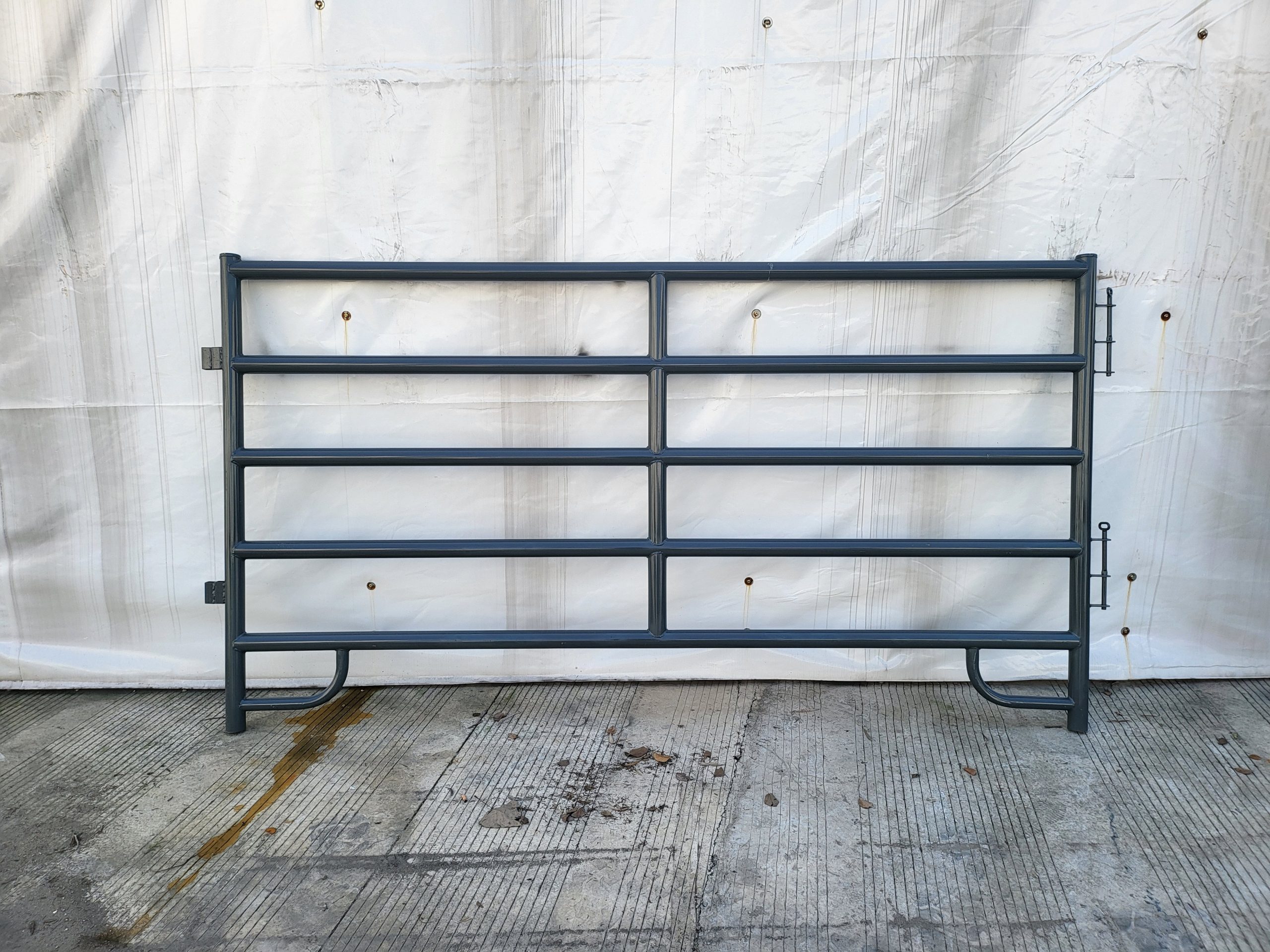
No universal percentage is reliable. Ten identical gates used twice a year do not create the same risk as ten gates opened daily in a handling alley. Build the spare list from four inputs: installed quantity, operational criticality, observed replacement rate and replenishment lead time. Add compatibility and storage life before approving the order.
Start with an asset register. Give every gate, panel line and connector type an ID. Record product model or drawing, installation location, livestock species, opening frequency, hardware type, finish and date placed in service. Take clear photographs of hinges, latches, pins and panel connections with a scale. This creates a reference when a component is damaged and the original purchaser is unavailable.
Keep “repair parts” separate from “complete replacement assemblies.” A spare pin may restore a connector, while a bent hinge bracket or cracked frame may require the manufacturer or a qualified repair provider. Do not authorize field welding solely because a loose hardware item is unavailable.
Which gate and panel parts should be inventoried?
List every part that can be removed or is likely to be damaged during use: hinge pins, hinge eyes, adjustable hinge components, latch pins, chains, keepers, stops, fasteners, panel pins, drop pins, clamps, connector loops, feet, caps and proprietary brackets. Include tools or retaining clips that are specific to the system.
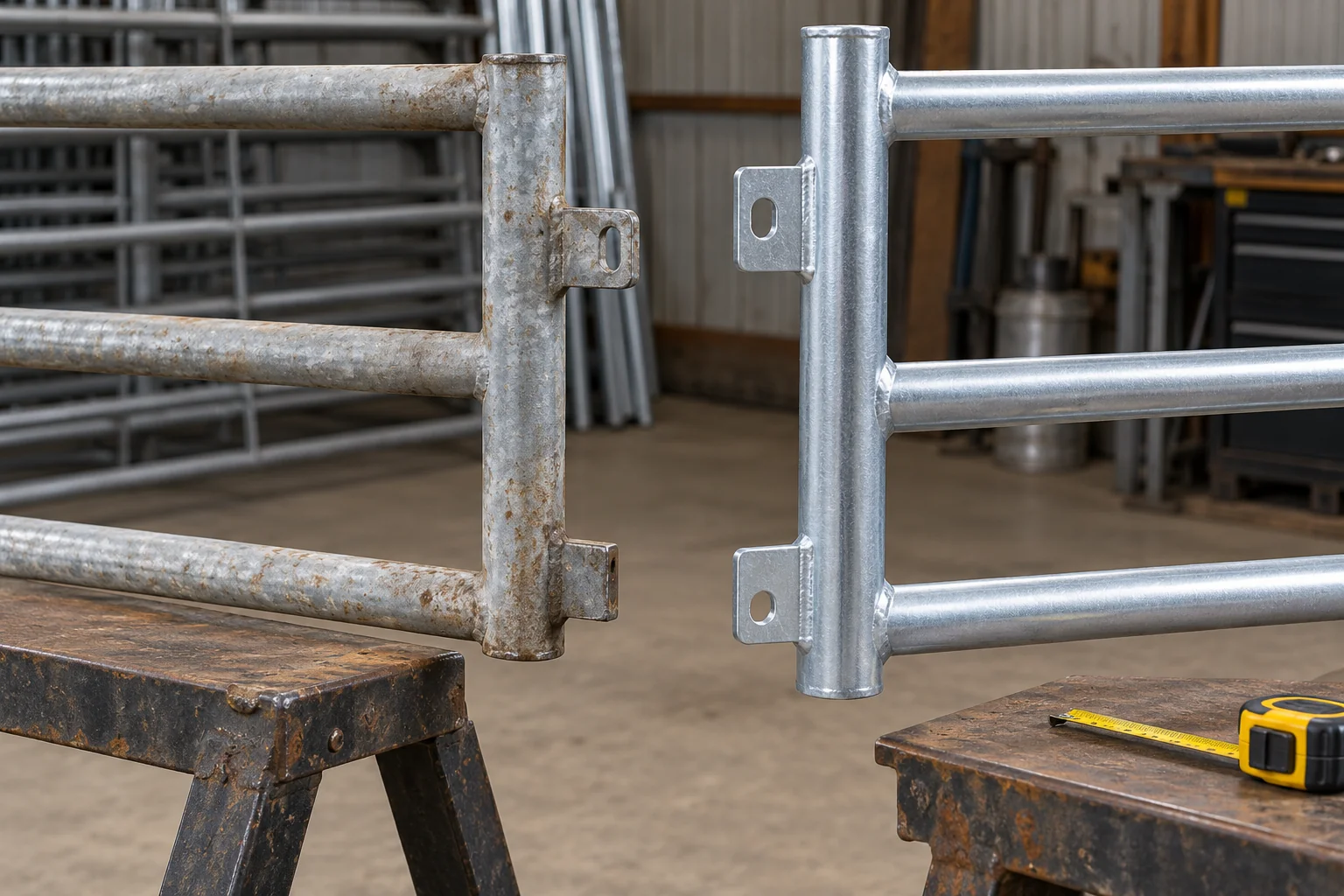
Photograph each item beside its package label and record critical dimensions. For a pin, that may include diameter, usable length, head or handle form and retaining method. For a clamp, record compatible tube size, bolt size and finish. Avoid naming a part only “large gate hinge”; similar-looking components may have different offsets or thread forms.
Check whether left- and right-hand versions exist. A latch receiver, hinge bracket or framed walk-through component may not be reversible. Also distinguish loose shipping hardware from factory-welded components. The spares list should not imply that a welded bracket can be replaced in the same way as a removable pin.
| Asset | Typical replaceable items to identify | Compatibility evidence |
|---|---|---|
| Swing gate | Hinge pins, latch, chain, keeper, fasteners | Gate drawing and installed measurements |
| Walk-through gate | Latch set, hinge components, stop | Handing and frame-interface drawing |
| Portable panel | Panel pins, chains, clamps, feet or caps | Connector detail and tube section |
| Fixed panel line | Clamps, bolts, post brackets and caps | Post and panel connection schedule |
How should criticality change the quantity?
Classify each location before calculating stock. A decorative outer gate may tolerate a short delay. A gate controlling a handling race, roadside entrance, quarantine pen or emergency route may require an immediate on-site replacement. One spare serving several compatible low-use openings can be sensible; a unique critical latch with a long lead time may justify its own spare.
Oklahoma State University Extension’s wildfire guidance tells ranchers to maintain gates so they open easily without tools. That operational requirement supports keeping critical opening hardware serviceable, but it does not prescribe a spare quantity. The ranch must decide which failures would block evacuation, animal care or vehicle access.
Use three levels: critical, important and routine. For each, define the maximum acceptable time out of service. Compare that time with supplier production, international transport, customs and local delivery. If replenishment takes longer than the acceptable outage, keep a compatible spare or a documented temporary-control plan.
What formula can a buyer use without pretending to know the failure rate?
Use a transparent calculation rather than a fixed percentage:
Recommended stock = expected demand during replenishment lead time + critical contingency + planned maintenance demand − usable stock already on hand.
Expected demand should come from ranch records. Count replacements by part number over a meaningful period, then adjust for the installed population and upcoming changes. If there is no history, begin with a modest initial kit for common removable parts, inspect frequently and revise after six or twelve months. Mark the result as an estimate.
Critical contingency is not automatically one unit. It depends on how many incompatible critical systems exist and whether a temporary safe substitute is approved. Planned maintenance demand covers known refurbishments, seasonal overhauls or expansion. Review minimum order quantities and pack sizes separately; buying a carton because it is convenient is not the same as needing every piece.
- Record each issue and replacement against the asset ID.
- Keep failed parts until the cause is reviewed.
- Separate wear, accidental damage, corrosion, loss and installation error.
- Update the forecast when new gates or panels are installed.
- Remove obsolete parts only after confirming no compatible assets remain.
How can buyers prevent incompatible spares?
Freeze the interface, not just the part name. Request dimensioned drawings for pins, holes, hinge axes, latch receivers, clamps and panel loops. Record thread type and pitch, material, finish and any retaining component. If the supplier updates a design, require a compatibility statement and identify the last order using the previous revision.
When receiving a new hardware batch, test representative parts on the installed equipment before distributing them to remote ranch locations. A pin that fits the hole may still lack the required usable length; a latch may engage but place the handle in an unsafe position. Document the check with the part and asset IDs.
Do not mix finishes or materials without review. A visually similar fastener may behave differently in the environment or create fit and corrosion concerns. Ask the supplier for the specified replacement rather than inferring equivalence from color. If local substitutes are allowed, record the approved specification and source.
What maintenance records should support the spare-parts plan?
Oklahoma State University’s meat-goat manual notes that swinging gates can sag, wire systems can stretch, welds can break and lumber can decay, and it recommends routine maintenance. Those observations explain why inspection history matters. They do not justify a universal replacement interval.
Inspect critical gates and panel connections on a schedule based on use and exposure, and after storms, vehicle contact or animal pressure events. Record looseness, misalignment, missing retainers, corrosion, sharp edges and difficult operation. A growing pattern of bent pins may indicate alignment or loading problems that more spare pins will not solve.
Assign a disposition to every finding: adjust, lubricate where permitted, tighten, replace hardware, isolate the opening, request structural repair or monitor. Keep the old part number, new part number, labor date and cause. This turns future ordering into evidence-based planning.
How should spares be packed, labeled and stored?
Order each kit against a drawing or part number. Ask the supplier to separate hardware by gate or panel system, label quantity and revision, and include a packing list. Protect threads, coated surfaces and small retaining pieces. Photograph the opened kit at receiving and count it before it is moved into general stores.
Store parts dry and organized by compatibility, not only by size. Use bins with part number, description, applicable assets, supplier and reorder point. Keep chains, pins and fasteners together only when they form a defined kit. Inspect long-stored coated items for corrosion or damage before relying on them during an emergency.
Review the inventory at least annually and whenever equipment is expanded or retired. A practical initial RFQ can include one priced recommended-spares schedule, but the buyer should approve quantities using site criticality and lead time. Compare the HRC accessories page with the gate range and panel range. Send the installed-product list through the contact page and request dimensioned compatibility information.
Should every ranch keep a complete spare gate?
Not automatically. A complete spare may be justified for a unique critical opening with a long lead time, but common interchangeable openings may be covered by hardware kits and an approved contingency plan.
Can locally sourced pins and bolts be used?
Only after confirming dimensions, material, finish, strength where relevant and retaining method. Similar appearance is not compatibility evidence.
When should the reorder point change?
Update it after failures, expansion, supplier lead-time changes, design revisions or retirement of compatible equipment.
How should purchasing lead time change the reorder point?
Break lead time into supplier production, export preparation, international transport, customs or border clearance, domestic delivery and transfer to the ranch location. Use realistic elapsed time rather than the fastest quoted transit. Recalculate the reorder point when freight mode, supplier, season or import route changes.
For remote operations, movement from a central store to the affected pen may be as important as international shipping. Assign one person to record withdrawals so the inventory does not show stock already taken to the field. Set a review trigger when usable quantity reaches the reorder point, and record open purchase orders separately from physical stock. This prevents an unconfirmed shipment from being treated as an available emergency spare.