
“Cattle panel” and “hog panel” are not universal specifications. The first may mean a tubular corral panel or a welded-wire stock panel, while hog panels usually refer to a closer wire grid supported by posts or a frame. Compare actual openings, tube or wire size, support, connectors, coating and animal pressure before selecting either system for a North American farm.
Are cattle panels and hog panels standardized product names?
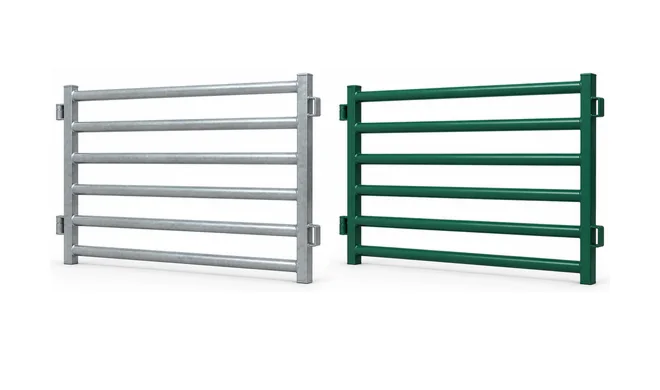
No. In North American retail and farm use, “cattle panel,” “stock panel” and “hog panel” can describe different welded-wire sheets, while livestock-equipment suppliers may use “cattle panel” for a freestanding tubular steel corral panel. Dimensions, wire gauge, tube section, opening pattern, coating and connectors vary by manufacturer. Compare drawings and specifications rather than names.
Begin by asking what job the panel performs. Is it a fixed pasture fence, a rigid corral wall, a temporary pen, a sorting area, a garden trellis or a barrier attached to posts? A welded-wire panel designed for fencing is not automatically interchangeable with a tubular panel intended to stand between livestock-panel connectors. The support system is part of the design.
Penn State Extension’s fencing overview recommends choosing fencing from the livestock species, number of animals, perimeter or subdivision role, topography, gates, lanes and existing infrastructure. It also notes that woven wire can be designed with different heights, gauges and grid sizes. That planning approach applies even though welded-wire panels and tubular panels are distinct products.
How does construction differ between the two panel families?
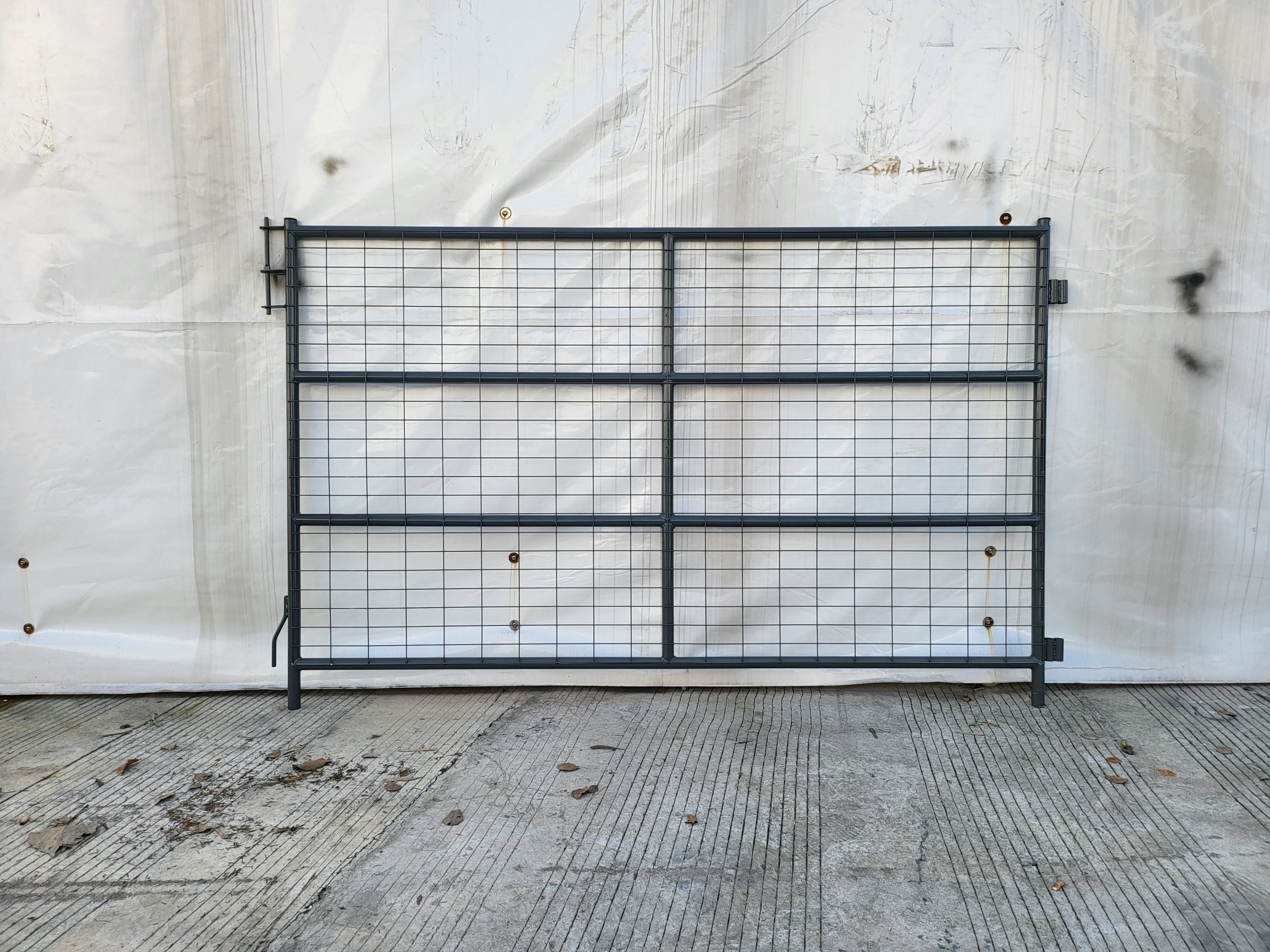
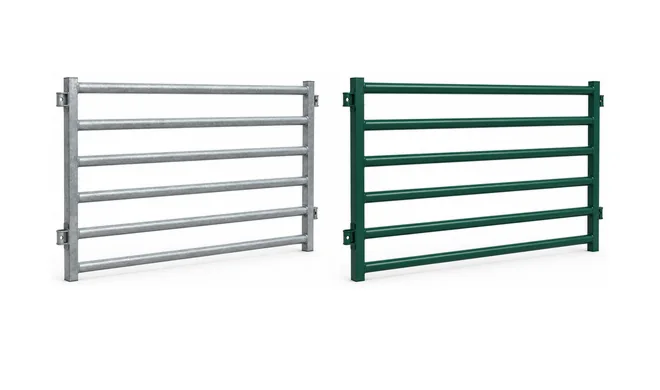
A tubular livestock panel typically has an outer frame, horizontal rails, vertical braces and connection hardware. Its rigidity comes from the tube sections, joint design, welds and frame geometry. It may include feet for portable use or pins and loops for joining adjacent panels. The buyer should request overall size, rail spacing, tube outside dimensions, wall thickness, material description, connection detail, finish and tolerances.
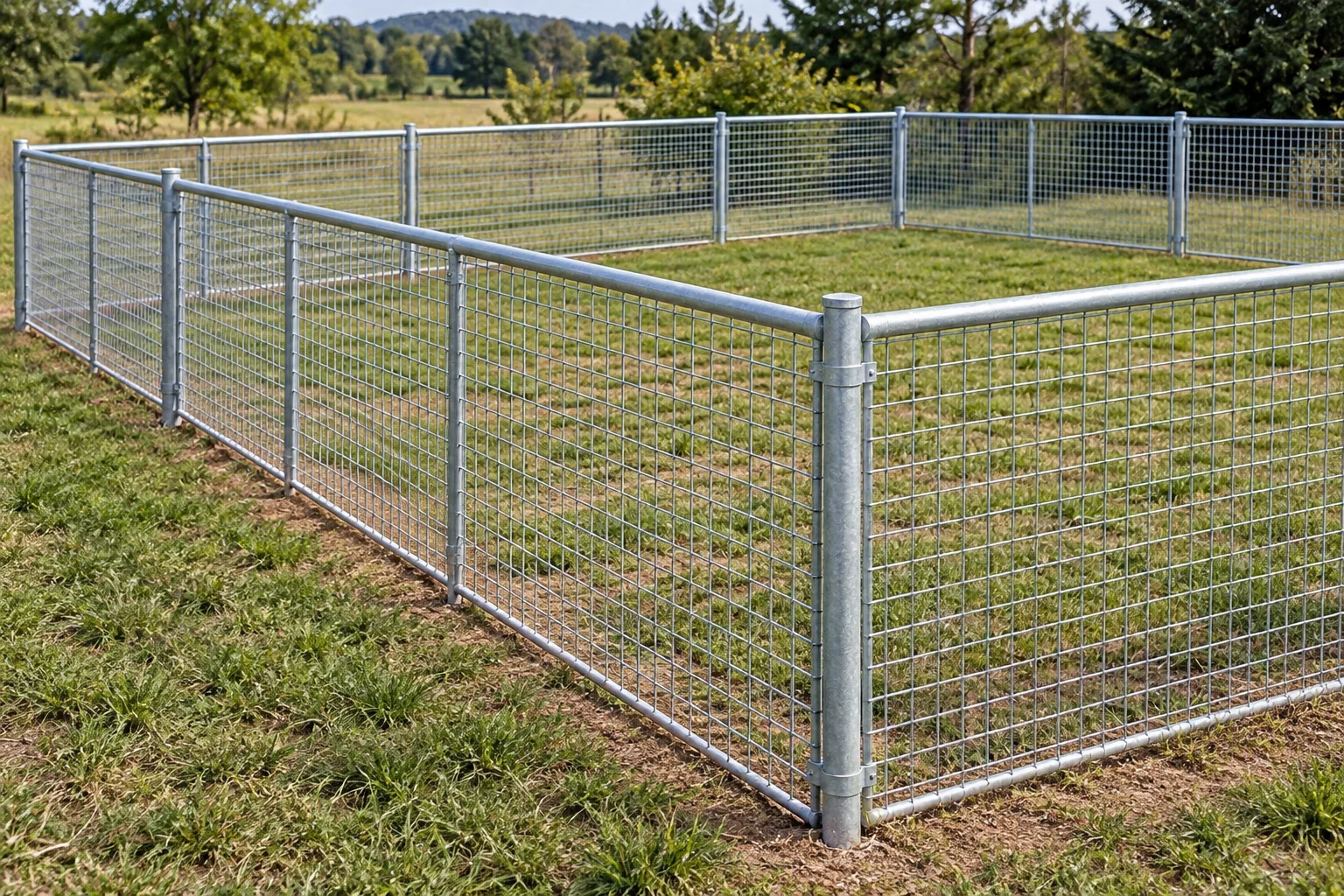
A hog-style panel is commonly a welded-wire grid supplied as a flat sheet. Its performance depends on wire diameter, grid pattern, weld integrity, coating and how it is attached to posts or a frame. Some products use smaller openings toward the bottom, but that arrangement is not universal. Request a grid drawing instead of relying on the word “hog.”
Do not infer strength from weight or appearance alone. A thick-looking tube can have a different wall than expected, and a dense wire grid can still need frequent support. Ask for the intended installation, post spacing or frame requirements and any available test or product data. If a supplier claims a standard, obtain the standard designation, edition and evidence for the quoted item.
Why does opening geometry matter more than the product label?
Measure the clear spaces an animal can contact, not just the number of rails or wires. Consider head size, horns, feet, knees and whether young stock share the enclosure. Also consider animals outside the pen, including dogs or wildlife. An opening that contains a mature cow may not contain a calf, piglet, lamb or goat kid.
For horses, opening geometry and projections require particular care. Penn State Extension advises that openings be either sufficiently small to reduce hoof entry or large enough to reduce entrapment risk, and emphasizes smooth, visible fencing without sharp projections. Those horse-specific recommendations should not be copied mechanically to cattle or hog facilities, but they illustrate why species and body size must drive the check.
Create a table of the smallest and largest animals expected during the panel’s service. Include seasonal young stock and temporary mixed-species use. Ask the supplier for actual clear vertical and horizontal openings after fabrication. If mesh is attached to a tube frame, review the edge termination and any gap between the mesh and frame.
What do official fencing references say about species and wire systems?
Iowa State University Extension’s livestock-fencing cost guide compares woven wire, barbed wire, high-tensile and temporary systems. It notes that all illustrated configurations can generally be used with cattle, while woven wire can be used with hogs. This supports a key buying point: cattle can be managed with several fence families, whereas hog applications commonly depend on a more continuous wire barrier. It does not certify any specific prefabricated panel.
The USDA Natural Resources Conservation Service’s Material Specification 591 identifies ASTM A116 for woven-wire fencing material and other standards for different wire products. That specification applies to NRCS field-fence materials, not automatically to welded rigid panels. If a buyer needs standards-based evidence, first determine whether the quoted product and application fall within the referenced scope.
Use extension and NRCS guidance to frame questions, then obtain local design advice for the farm. Soil, frost, terrain, animal pressure, post system and local rules can change what is appropriate.
How do support and installation requirements differ?
A freestanding tubular panel may connect directly to neighboring panels and use feet or anchors, but its stability still depends on layout, corners, surface, animal pressure and manufacturer instructions. A welded-wire sheet normally needs posts, rails or a separate frame. Its wire grid should not be expected to bridge long distances simply because the sheet feels rigid at the store.
For either system, map corners, gates, slope changes and high-pressure areas near feed or water. Penn State notes that fencing design depends on topography and existing infrastructure. A straight panel cannot follow every contour without creating bottom gaps or high contact points. Measure grade at panel ends and intermediate supports.
| Buyer question | Tubular livestock panel | Welded-wire or hog-style panel |
|---|---|---|
| Primary structure | Tube frame and rails | Welded wire grid, often post- or frame-supported |
| Key opening check | Clear rail spacing and end gaps | Grid dimensions and edge gaps |
| Connection check | Pins, loops, clamps or chains | Clips, staples, ties or framed attachment |
| Terrain check | Feet, anchors and bottom clearance | Post alignment, tension or frame fit |
| Evidence | Tube and assembly drawing | Wire, grid and support specification |
Which system is better for cattle, hogs or mixed use?
For cattle pens and corrals where rigid modular sections, gates and repeated layout changes are priorities, tubular livestock panels may be the more relevant product family. For a hog perimeter where smaller openings and continuous coverage are required, a suitable wire system with properly designed posts or frames may be more appropriate. These are selection tendencies, not universal rules.
Mixed use is more demanding. A panel selected for mature cattle may have openings unsuitable for smaller animals. Adding mesh to a tubular panel can change weight, wind exposure, cleaning and snag points. If a retrofit is proposed, approve the attachment method and edge treatment; do not assume cable ties or improvised wire create a durable livestock barrier.
Separate permanent perimeter fencing from interior handling equipment. A tubular panel can be excellent inside a yard without replacing the farm’s perimeter fence. Conversely, a field wire fence may contain animals across a long boundary but be inconvenient as a movable sorting pen. Define the duty before comparing price per panel.
What should be included in the RFQ?
Send the supplier a site sketch, species and age range, group size, panel function, permanent or portable use, ground conditions, required openings, gate locations and connection method. Ask for an elevation drawing and detail of every connector, foot, anchor or post attachment. List the finish and evidence required without making unsupported service-life claims.
- Overall panel length and height
- Actual tube or wire dimensions and material description
- Clear rail or grid openings
- Frame, brace and edge details
- Connector and compatible gate information
- Post, anchor or support requirements
- Finish process and inspection evidence
- Packing, labeling and replacement-part availability
Review HRC’s livestock panel range, the mesh panel page and the tubular heavy-duty panel page as configuration references. Request a current drawing through the contact page; the final quotation, not the generic name “cattle panel” or “hog panel,” should control the order.
How should buyers compare the installed cost and approve a sample?
Normalize quotations before comparing price. Convert each offer into the same installed length or enclosure layout and include posts, connectors, gates, anchors, freight, unloading, labor and replacement parts. A lower panel price can be misleading if the system requires more supports or a separate frame. Conversely, a framed tubular panel may add cost where a properly designed permanent wire fence already performs the required duty.
For a large order, request an approved drawing or production sample. Check it with the intended post, connector and gate; inspect edges, wire ends, welds, coating and actual openings. If young stock or mixed species are involved, review the smallest animal expected rather than the average mature animal. Record the approved configuration, dimensions and revision so later additions or replacement panels match the installed system.