
A five-foot livestock gate can suit a defined animal-and-handler route, but it should not be treated as a universal ranch entrance. First confirm whether “five feet” describes the leaf, post spacing or installed clear opening. Then compare that usable width with the actual animals, handler position, equipment envelope, turning path and emergency access. Main vehicle routes often need a substantially wider gate.
What does “five-foot livestock gate” actually measure?
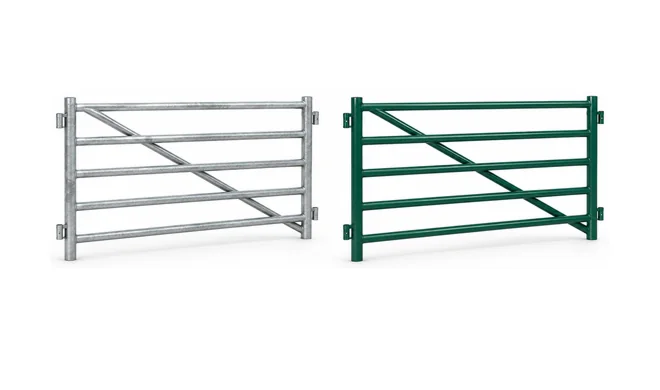
The phrase “5′ livestock gate” can mean a nominal five-foot leaf, a five-foot gap between posts, or a five-foot opening that remains after installation. Those are different quantities. In feet and metric, five feet is 60 inches, approximately 1.52 meters. That conversion is certain; the usable passage at a real site is not. Hinges, latch receivers, post size and the point at which the open leaf stops can reduce it. A sloping approach or corner can make the effective path still narrower.
For a useful quotation, draw a plan view and label three separate numbers: clear distance between fixed obstacles, width of the gate leaf, and minimum unobstructed passage when the gate is parked open. Show the hinge axis and swing radius. Include the ground line in an elevation. If the supplier offers several rail patterns, do not confuse “five-rail” with “five-foot.” Rail count describes a different feature and does not state clear width.
Ask for a dimensioned drawing in both inches and millimeters. A photograph cannot prove the opening, tubing, wall thickness or hardware rating. The buyer should approve the drawing before the gate is fabricated, and the installer should check the post positions before setting them permanently.
Where can a five-foot opening make sense?
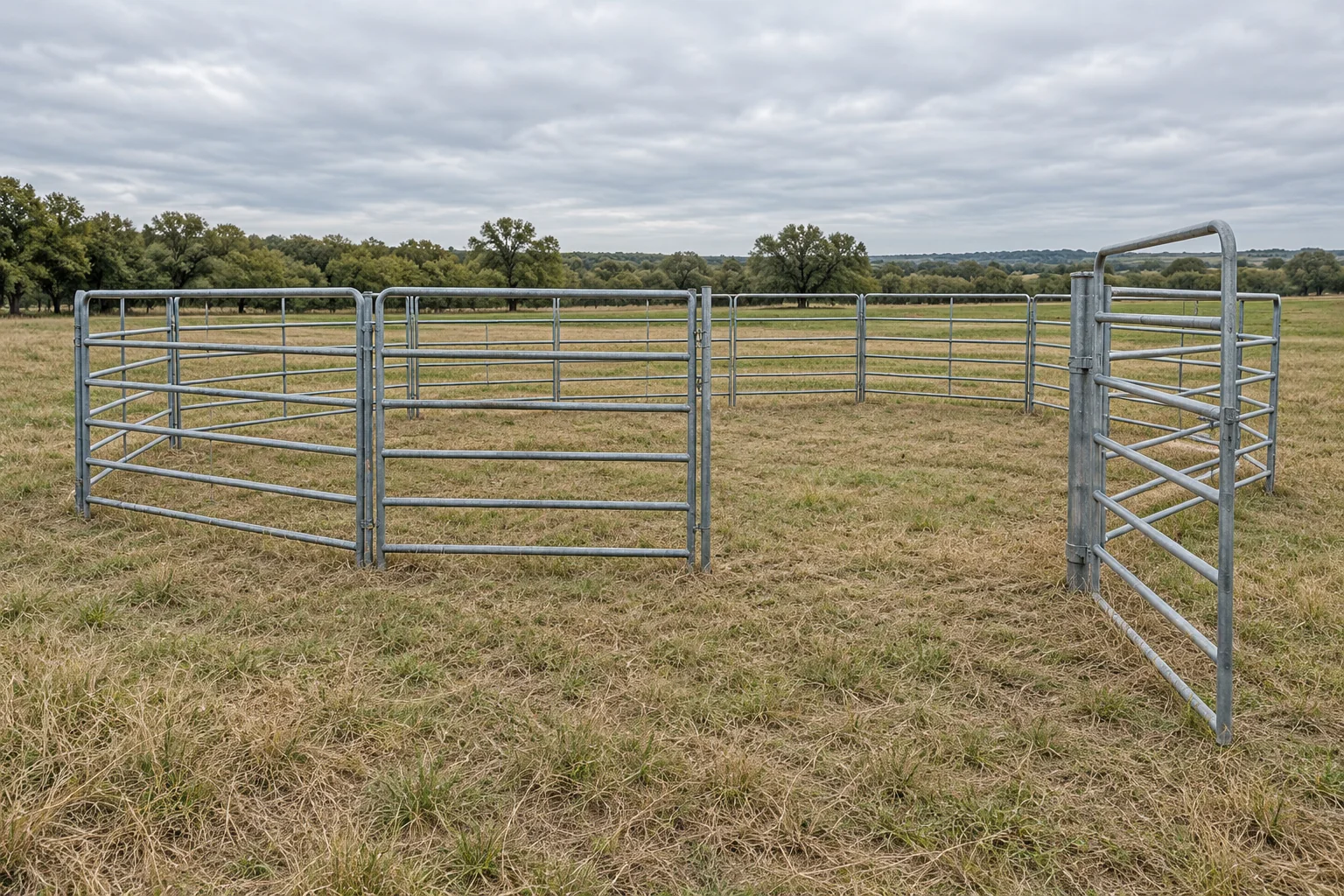
A narrow secondary opening may be practical when an adult handler moves one animal at a time and the route does not carry machinery. For horse facilities, Penn State Extension specifically prefers five feet for a horse-and-handler gate while recommending a separate, much wider vehicle entrance. That is evidence for a horse context, not proof that every cattle alley or corral gate should be five feet wide.
For cattle, decide the opening from the movement task. Is it a person passing between pens, a single animal being led, a small group entering a holding pen, or a sorting gate used under pressure? The answer affects required width, placement and swing. A five-foot gate should not be put in a cattle flow path solely because it is available. Cattle behavior, group size and handler position matter. Oklahoma State University Extension’s handling safety guidance stresses proper gate placement and the relationship between holding pens, alleys and animal movement.
Where a person needs routine access but animals should remain contained, a dedicated walk-through arrangement may be useful. Review the walk-through gate option as a starting point, then confirm its actual dimensions and latch. Do not presume a photographed design suits every herd or site.
When should the ranch plan a wider gate?
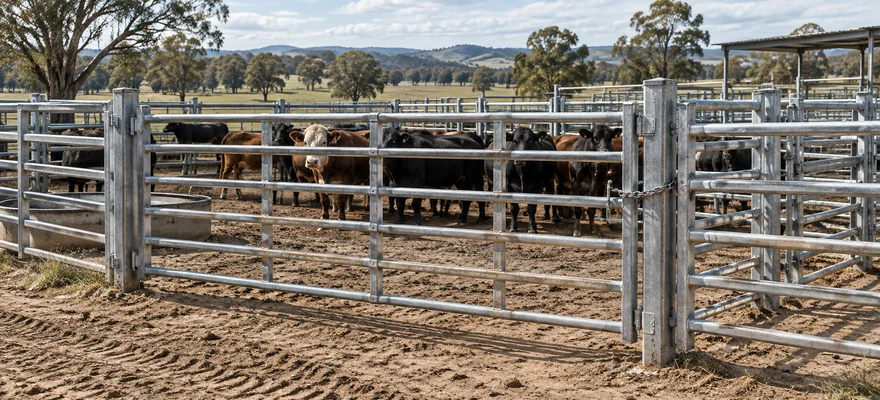
Any machine route deserves its own measurement. Record the widest tractor, utility vehicle, feeder, mower, trailer or skid-steer attachment that must cross the fence. Include mirrors, guards, loads, steering angle and a practical margin for imperfect approach. Confirm that the leaf can be secured fully open and that a second gate or fence does not obstruct the turn. Do not use a generic vehicle width as a substitute for the machine your ranch owns.
The Penn State horse-facility guide gives a useful contrast: it calls for at least 12 feet for easy vehicle and tractor passage, up to 16 feet in some cases. This is a source-specific recommendation for horse facilities, not a universal legal minimum or a promise that a particular truck will fit. A cattle ranch should calculate its own envelope and turning space in the same way.
Cattle flow can also require more room, but wider is not always better. A sorting alley too wide for the handling method may make control harder. Oklahoma State’s corral planning guide and its safety guide address alley, pen and working-area dimensions in their own contexts. Use their layout logic and adapt dimensions to the herd and local design professional’s advice. A field entrance, a sorting alley and a single-file working chute are different spaces; one gate width cannot be copied across all three.
| Route | Five-foot gate as a starting idea? | What to check |
|---|---|---|
| Horse plus handler | Potentially; Penn State prefers five feet | Installed clear width, swing and footing |
| One-person service route | Possibly, but a smaller purpose-built opening may be better | Containment, latch access and escape route |
| Cattle group movement | Site-dependent | Herd behavior, pen flow and handler position |
| Tractor or feed equipment | Usually requires an independent equipment assessment | Actual machine envelope and turn |
| Trailer or emergency vehicle | Do not assume it fits | Vehicle width, approach and local access needs |
How do gate location and swing affect the useful width?
A gate can have enough nominal width yet fail at the junction. A tight right-angle approach may prevent a trailer from using the full span. A leaf that opens toward a stock tank, a raised track or a slope may stop before it lies flat. A latch post set inside the corridor may create a pinch point. Draw the approach as well as the opening.
For animals, consider what they see on the other side and where they can stop. Avoid forcing cattle around a sharp corner immediately after the gate if the aim is calm flow. Place the latch so the handler can control the leaf from a safe position. The OSU handling safety guide discusses gate placement as a way to reduce difficult movement and worker exposure. Its diagrams should be used as planning references, not copied as a certified HRC system.
Walk the route with the intended operators. Open the gate, simulate moving an animal or equipment through, close it, then repeat while another gate is occupied. That rehearsal often exposes conflicts that a catalog dimension hides. Mark the location and angle of any gate stop in the approved plan. Check ground clearance at the low point of the swing after grading, including places where mud or winter buildup might occur.
What specifications should a buyer request for a five-foot gate?
The supplier’s reply should answer the exact use, not just list a nominal size. Request the leaf length, installed clear opening, overall height, rail spacing, tube and frame dimensions, wall thickness, hinge type, latch type, post interface, swing direction, finish process and packaging. If load or corrosion performance is claimed, request the underlying test method and record for that quoted configuration. Do not rely on terms such as “farm grade” or “heavy duty” without measurable details.
Ask whether the gate is shipped with hinges and latch or whether those are separate lines. If the existing posts are to be reused, send their diameter or section, spacing, material and condition. Have the supplier identify tolerances that matter to field fit. Record any required clearance from the ground, remembering that the installed value will depend on local grading. A five-foot leaf bolted to unsuitable posts is not a completed gate system.
For a new order, include the animal type and route classification. If both horses and cattle will use the entrance, explain which uses are frequent and which are occasional; assess visibility and entrapment risks for both. If the gate is also an equipment entrance, supply the actual equipment dimensions. The quote should say what is included, what is excluded and what remains to be verified on site.
How can you compare two gate quotations fairly?
Put the offers in one table with the same definitions. Compare installed clear width rather than nominal length; compare hardware supplied rather than photographs; compare documented finish process rather than color alone. A lower initial price might omit posts, latches, mounting brackets or a needed drawing. An expensive gate may still be wrong if it opens in the wrong direction.
- Mark each opening on a scaled site plan and assign a task: animal, person, equipment or mixed.
- Measure the approach, post spacing, ground profile and largest object that must pass.
- Specify the minimum installed clear width, swing and hardware operation.
- Request the same drawing and material details from each supplier.
- Review the proposal with the person who will install and operate the gate.
- Confirm parts, packaging, replacement hardware and delivery terms before approval.
The HRC livestock gate range can help frame a product discussion. The exact five-foot configuration should be confirmed in the written quotation; the product gallery is not a dimensioned schedule. Send a site sketch via HRC’s contact page and ask for the installed-opening drawing that matches your intended use.
Frequently asked questions about five-foot livestock gates
Is a five-foot gate the same as a five-rail gate?
No. Five feet describes a length or opening; five rails describes a frame arrangement. Either can vary independently. Ask for both values on the drawing.
Can a five-foot gate serve a horse paddock?
It may suit a horse-and-handler route if the actual clear opening and site layout work. Penn State prefers a five-foot horse-and-handler opening. Vehicle and tractor routes need a separate assessment.
Can it serve a cattle handling corral?
Possibly at a particular transition, but the decision depends on animal flow, group size and handler position. Review the entire corral path rather than assigning a gate from width alone.
How do I confirm the opening after installation?
Measure the narrowest usable passage with the leaf secured at its intended open angle, after posts, hinges and latch hardware are installed. Also check clearance along the approach and through the swing.