
A useful sheep handling pen moves a manageable group from a holding area into a race, then toward clearly controlled sorting exits. Keep the route legible to the flock, place gates where handlers can operate them safely, and inspect every junction for gaps or projections. Final dimensions and capacity must be set for the actual flock and site, not copied from a photograph.
What jobs must the sheep handling pen perform?
Start with the work, not a panel count. A pen used only to draft ewes into two groups can be simpler than a facility used for vaccination, weighing, foot care and loading. Record the normal flock size, the number processed in one session, whether lambs follow ewes, and how many people operate the system. Then list the destinations animals need after each task. This prevents a quotation from solving the wrong problem.
Penn State Extension’s sheep-handling guidance identifies a holding pen and working chute as basic elements; access gates, a scale, sorting gate and loading area are useful when the operation requires them. That is a functional checklist, not a universal shopping list. For every proposed module, ask what task it supports and what happens without it. If nobody can answer, postpone that module.
Prepare a one-page brief before inviting suppliers to quote. Name the flock classes, handling frequency and seasonal changes. Distinguish routine treatment from occasional loading because those jobs may need different routes. A component that is convenient on a demonstration farm may not be needed on yours.
How should sheep move from holding area to race?
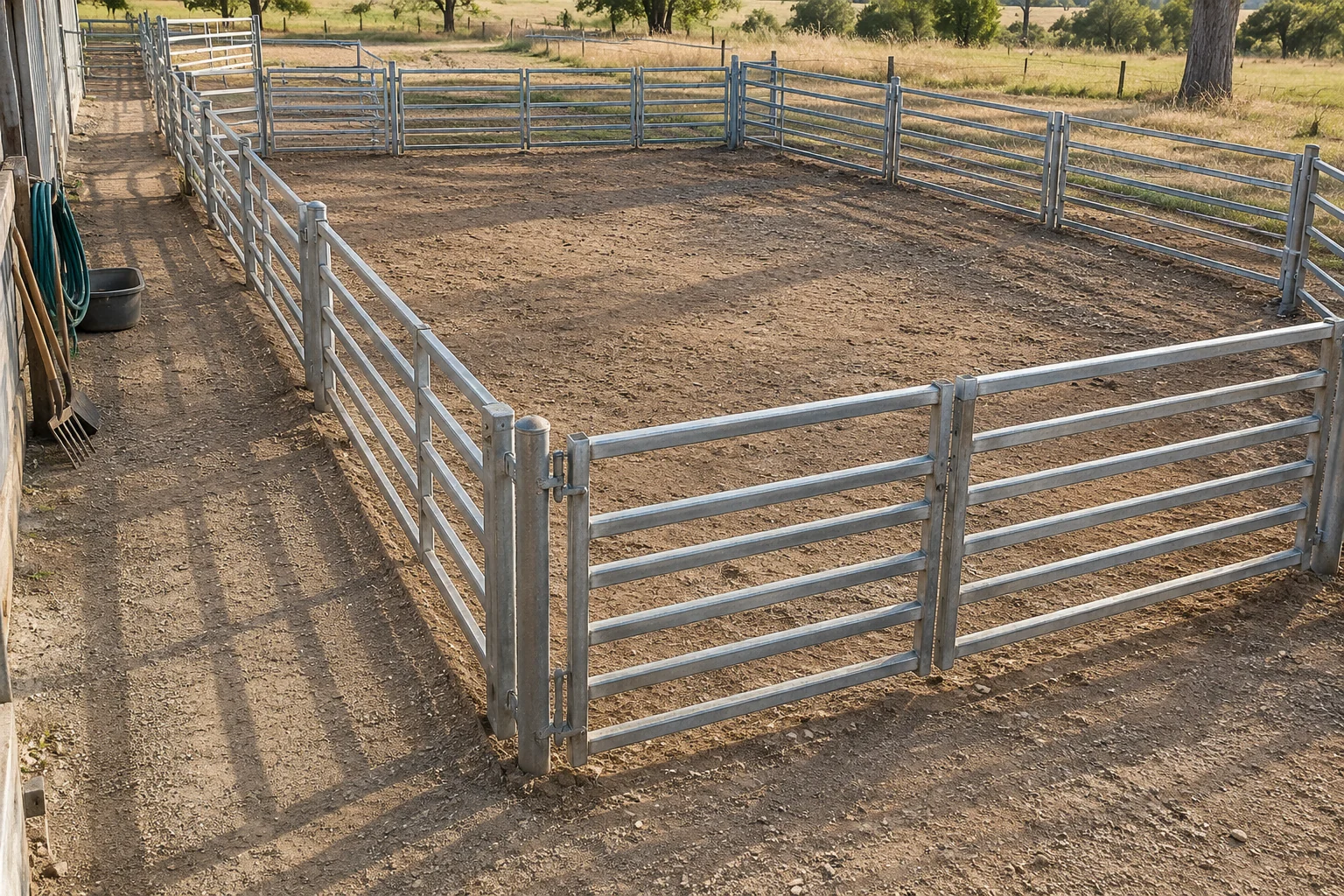
Sketch the route as collection, holding, controlled entry, race and destination. The holding area should contain a manageable working group without forcing animals into a dead-end corner. Position the entrance so sheep can perceive a continuing route while handlers regulate the group from outside the most crowded point. The exact area and race width need measurements of the animals and site; an illustration cannot establish them.
The Penn State Extension handling-system guide recommends a level location where possible and attention to sharp shadows, outside distractions and bright light in the animal’s eyes. It also discusses curved approaches and solid-sided panels. These are considerations to test in context, not proof that every curve improves flow.
Walk the proposed path before ordering. Mark any place where sheep can turn back, bunch against a gate or stop because they see equipment ahead. Identify where the handler will stand while moving the entry gate. If that person must enter the incoming lane, revise the drawing. Also plan how animals return to pasture or housing after sorting; otherwise the exit route can interfere with the next group entering.
What makes a working race practical rather than merely narrow?
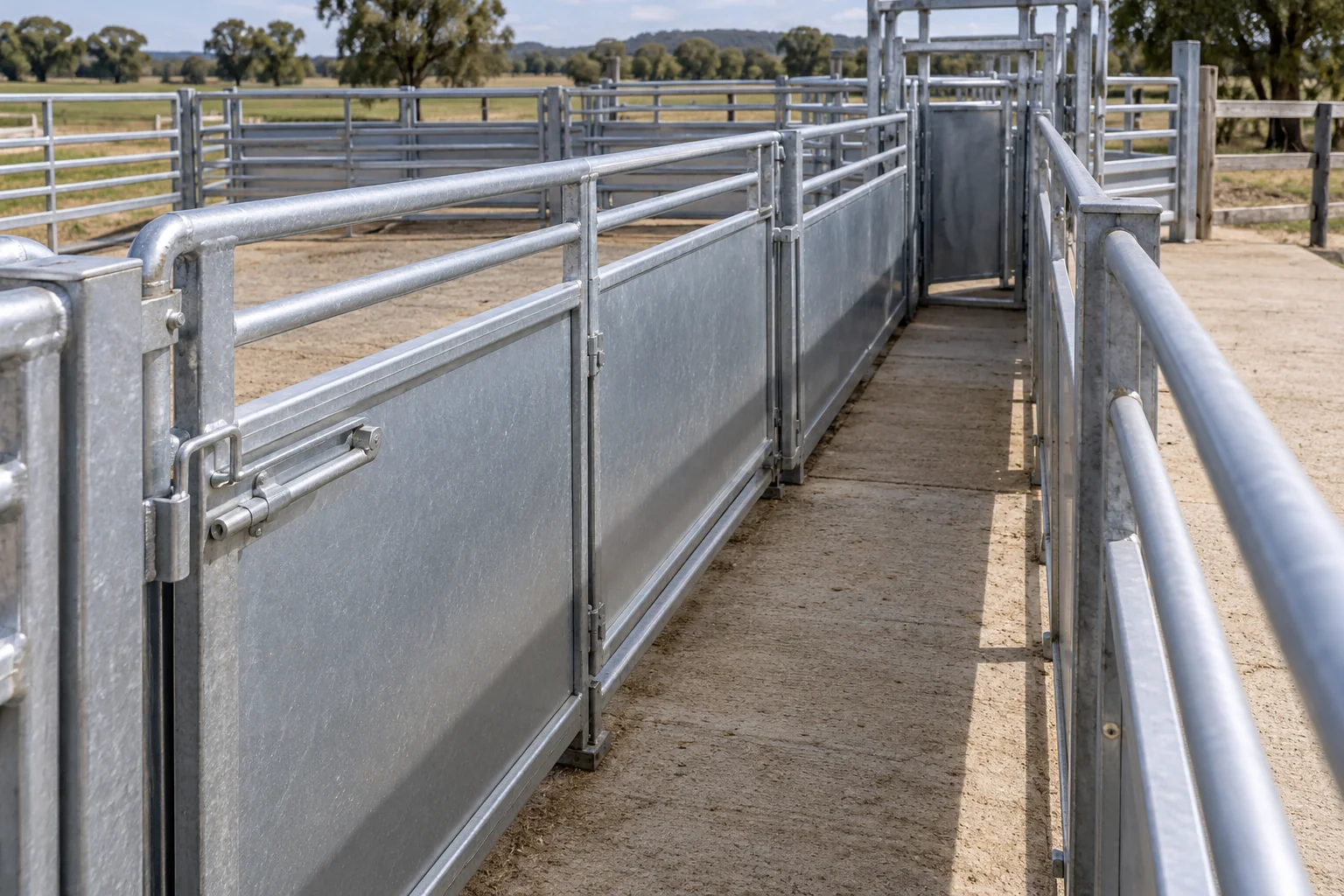
A race has to control forward movement while allowing the planned task to be performed. For weighing or treatment, locate equipment and staff access on the plan, not just the animal lane. Check whether a worker can reach the animal and operate a side panel without crossing behind a moving gate. A compact-looking layout may become awkward when someone carries supplies or cleans the floor.
Choose solid or open sides according to the operation. Penn State Extension notes that activity outside the race, objects on panels and abrupt lighting changes can cause sheep to hesitate. Its guidance also calls for checking hardware that projects into the animal route. That extension article is useful design context, but it does not certify any particular product.
Ask for a plan and elevation showing race panels, gate swing, connections and service access. If animals of very different sizes will use the route, record how adjustments are made and who sets them. Do not infer tube wall thickness, coating quality or load capacity from a photograph. Request the actual specification and acceptance method for those claims.
Where should the sorting gates and exits go?
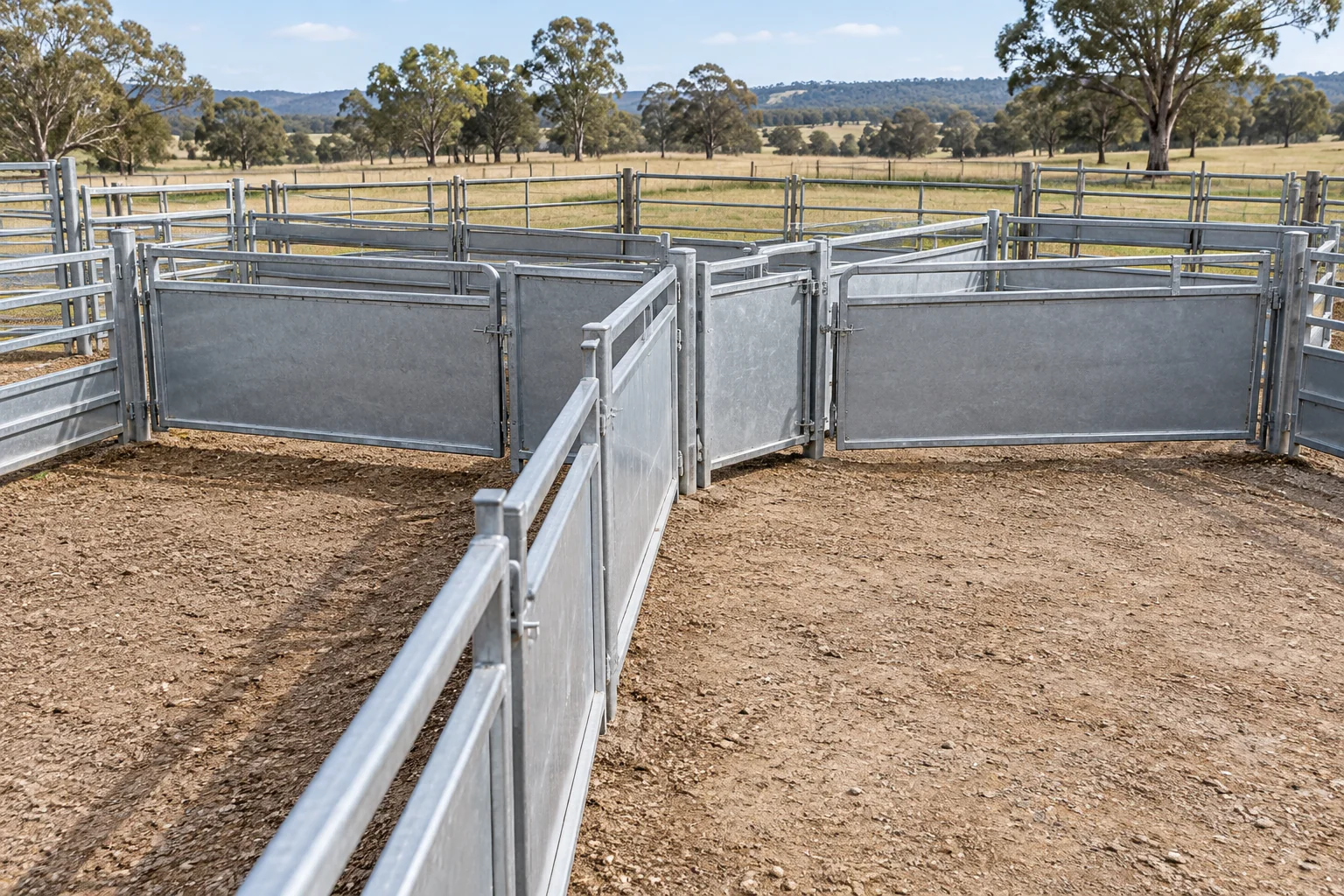
Place each sorting decision after the working point, where the handler can see the animal and operate the correct exit without standing in its path. A two-way draft leads to two controlled destinations. A three-way draft needs another receiving area and enough room to use it. Count the decisions in a normal work session before specifying gate quantity.
Show every gate in open and closed positions on the drawing. A partly open leaf should not block a worker path or create a pocket where a sheep becomes isolated. Specify which side the latch must be reached from and how the receiving pen will be observed. The HRC livestock-gate range can start a configuration discussion; the ordered hardware and dimensions still need to be confirmed in a drawing.
Do a dry run using temporary markers. One person calls a sorting decision while another walks each gate through its full travel. If the operator cannot see the destination or must cross animal flow to change a gate, revise the junction. Small layout errors are much easier to correct on paper than after posts and panels are installed.
How can handlers avoid pinch points and unnecessary crossings?
Trace a continuous outside working route from the entrance to the race access and sorting controls. Put frequently used latches where they can be operated from a stable position. Check hinged edges, gate stops and connectors for hand pinch points. Check whether damaged rails or bolt ends project into the animal lane. A walkway is not useful if workers must climb a panel to reach the next station.
Penn State Extension’s farm-animal safety guidance emphasizes planning an escape route before entering a pen. Local safety rules and the ranch’s operating procedures still control the final design. Make the people who will handle the flock review the drawing; procurement staff cannot infer daily movements from a component list alone.
Conduct two review passes: follow an animal through the system, then follow a worker carrying normal equipment. Look at where a worker waits when an animal stops and how a gate can be closed without trapping a hand. If either route depends on improvised behavior, the plan needs another revision.
What belongs on a supplier comparison sheet?
Compare offers by function and evidence, not marketing adjectives. The table lists questions to resolve rather than universal sheep-pen dimensions.
| Area | Ask the supplier | Confirm on site |
|---|---|---|
| Holding | Which panels, gates and connectors are included? | Working group size and ground condition |
| Race | How is access provided for the intended task? | Animal sizes and worker position |
| Sorting | What are gate swing and latch positions? | Receiving pens and sightlines |
| Connections | What gaps remain after assembly? | Existing posts and level changes |
| Maintenance | Which wear parts are replaceable? | Cleaning and inspection access |
Request a revision-controlled drawing, bill of materials and finish description. If a quote says “heavy duty,” ask for measurable tube and assembly specifications and the evidence behind any performance claim. Distinguish manufacturer documentation from a conceptual image. Record unresolved exceptions instead of treating silence as compliance.
What should be checked before installation?
Mark the footprint with temporary stakes or tape, including the outside service route and each gate’s open position. Walk both animal and worker paths. Look for uneven ground beneath bottom rails, drainage problems, places where a scale or wheelbarrow cannot pass, and exits that point animals back toward the entrance. A paper plan often misses these conflicts.
Check interfaces to existing gates, shed walls and concrete edges. Obtain a connection detail instead of leaving installers to fabricate an improvised adapter. If site dimensions differ from the supplier’s drawing, resolve them before shipment. The cost of moving a hinge on a drawing is much lower than reworking a finished yard.
Decide who inspects the system after use. Latches, pivots and connectors wear; surfaces need cleaning and visual checks. A good arrangement allows that work without dismantling the animal route. Keep an approved drawing with the equipment records so later additions use the same interfaces.
What should an overseas buyer send with the request for quotation?
Send one marked-up plan rather than several disconnected product screenshots. State flock classes, normal batch size, intended tasks, required exits and site constraints. Include real site measurements and photographs, clearly separating them from design references. Ask the supplier to list assumptions and exceptions next to the proposed drawing.
For an overseas order, use component labels that match the quotation, packing list and installation plan. A named gate should have the same name in all three documents. This reduces confusion when the installation team was not present during purchasing discussions. Do not put an unverified container quantity, delivery date or product rating into the article or brief as if it were a confirmed fact.
The HRC handling-equipment overview identifies component families worth discussing. To review a particular configuration, send HRC your annotated layout and flock brief. Suitability depends on the confirmed design and the actual animals, not a generic example.