
A heavy-duty label is not enough to select a livestock panel. Ask for the complete construction specification, the intended application and evidence supporting any performance claim. Compare the entire assembly—including rails, joints, connectors and supports—under stated conditions rather than ranking panels by appearance or weight.
What must a heavy-duty claim explain?
Overseas buyers often receive quotations that use the same reassuring phrase but describe different products. One supplier means a larger tube; another means a heavier frame or a configuration intended for busier yards. Unless the offer explains the term, comparing prices becomes an exercise in comparing labels.
Separate three questions: what is supplied, what work it is intended to do, and what evidence supports that intended use. A dimensioned drawing answers the first question. An application statement helps with the second. A relevant calculation, test report or documented assessment may address the third, depending on the claim and project.
Do not convert a marketing description into a load rating. Equally, do not demand an impressive-looking certificate without checking what it covers. The goal is useful evidence linked to the exact design being purchased.
This checklist is a procurement framework, not a structural design method. Where the consequences of failure are significant, have the proposed assembly reviewed by a suitably qualified professional familiar with the application.
Which specifications should be recorded before comparing prices?
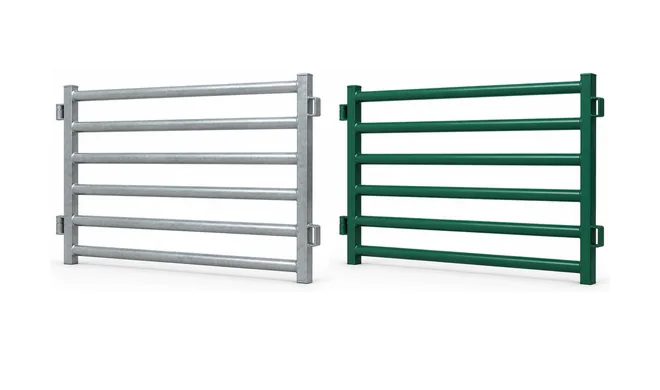
Build one comparison sheet and ask each supplier to complete it. Missing information should remain visible rather than being replaced with assumptions. A quotation that lists only overall dimensions and finished weight is not yet a complete construction description.
| Item | Requested detail |
|---|---|
| Main members | Profile, outside dimensions, wall thickness and tolerances |
| Material | Specified steel grade and supporting records where required |
| Geometry | Length, height, rail positions and any intermediate supports |
| Connections | Brackets, pins, retention method and mating components |
| Installation | Support arrangement and application limitations |
| Finish | Process, specified acceptance requirements and repair method |
The HRC heavy-duty livestock panel page provides a starting configuration for discussion. Its reference examples should be replaced by the approved specification for your actual order.
Why must tube size and wall thickness be considered separately?
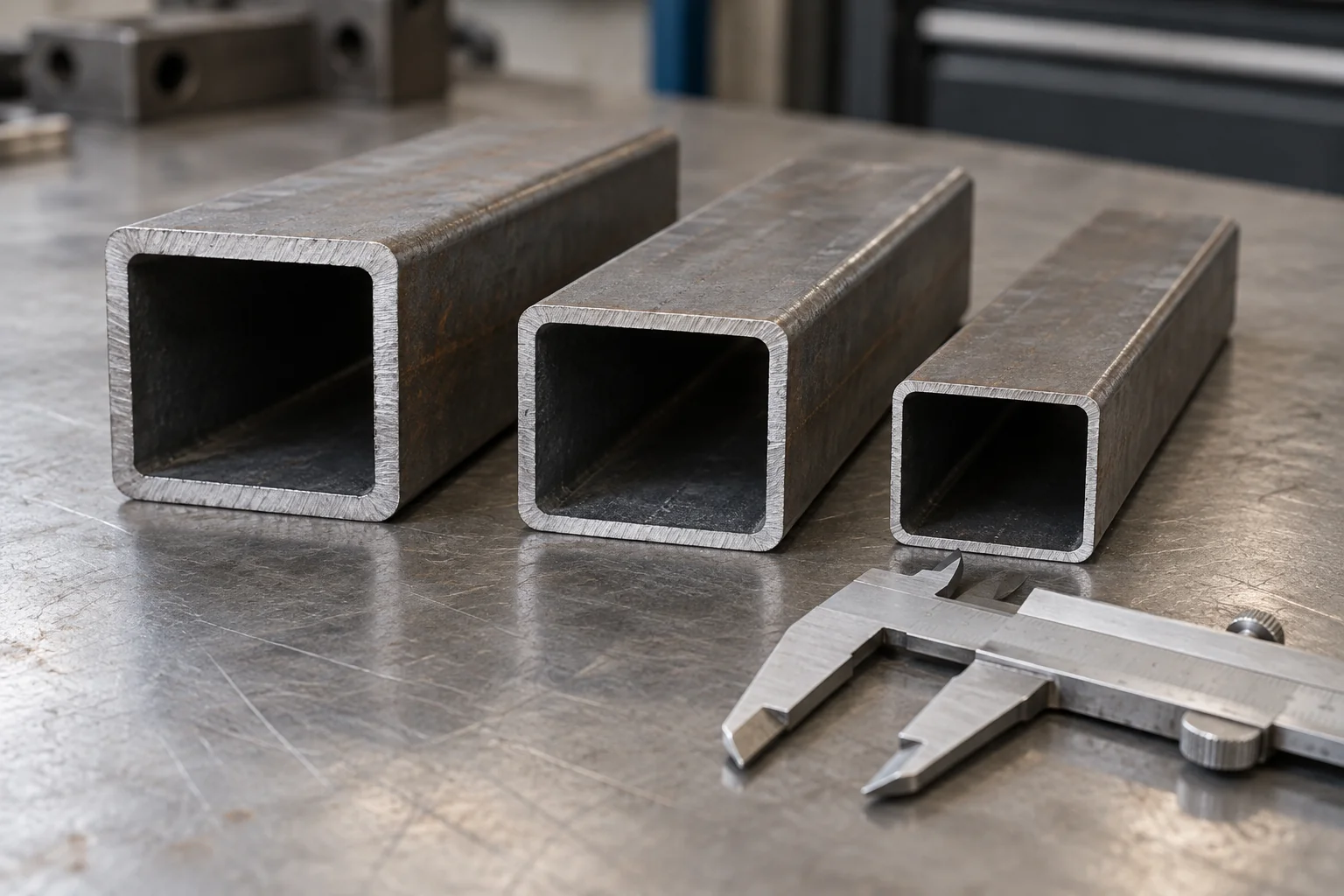
A large outside dimension does not reveal the wall thickness. A heavy finished panel does not reveal where its material is distributed. Ask for both dimensions and the orientation of non-round members, then retain those details in the drawing and bill of materials.
Record nominal values and permitted variation separately. Otherwise, a buyer may treat a nominal figure as an absolute minimum while the supplier applies a manufacturing tolerance. Agree how measurements will be made and which finished or representative components will be checked.
Request the material designation rather than accepting a phrase such as quality steel as the complete answer. If traceable material records are required, specify their relationship to the supplied production batch. A generic document for another material or an unrelated batch does not resolve the question.
These checks make offers comparable; they do not let a buyer calculate safe animal loads from a photograph. Section geometry, span, joints and support conditions still need to be considered together.
What should you ask about a stated load rating?
A number is meaningful only with its conditions. Ask whether a claimed load relates to an individual rail, a complete panel or several connected panels. Confirm how the sample was supported, where the force was applied and what counted as an acceptable result.
- Which drawing revision and material specification were evaluated?
- Was the force concentrated at one point or distributed?
- Was it a static test or another defined loading method?
- What deformation or damage was allowed?
- Did the evaluation include production connectors and supports?
A laboratory setup with rigidly restrained ends should not be treated as equivalent to an unspecified field installation. Likewise, a result for a shorter panel cannot automatically be transferred to a longer one because the tube size looks identical.
If no rating is supplied, record that honestly. Ask for an application recommendation and appropriate assessment rather than inventing a rating or assuming the panel is unsuitable solely because its brochure omits a number.
How do welds and connectors affect the purchasing decision?
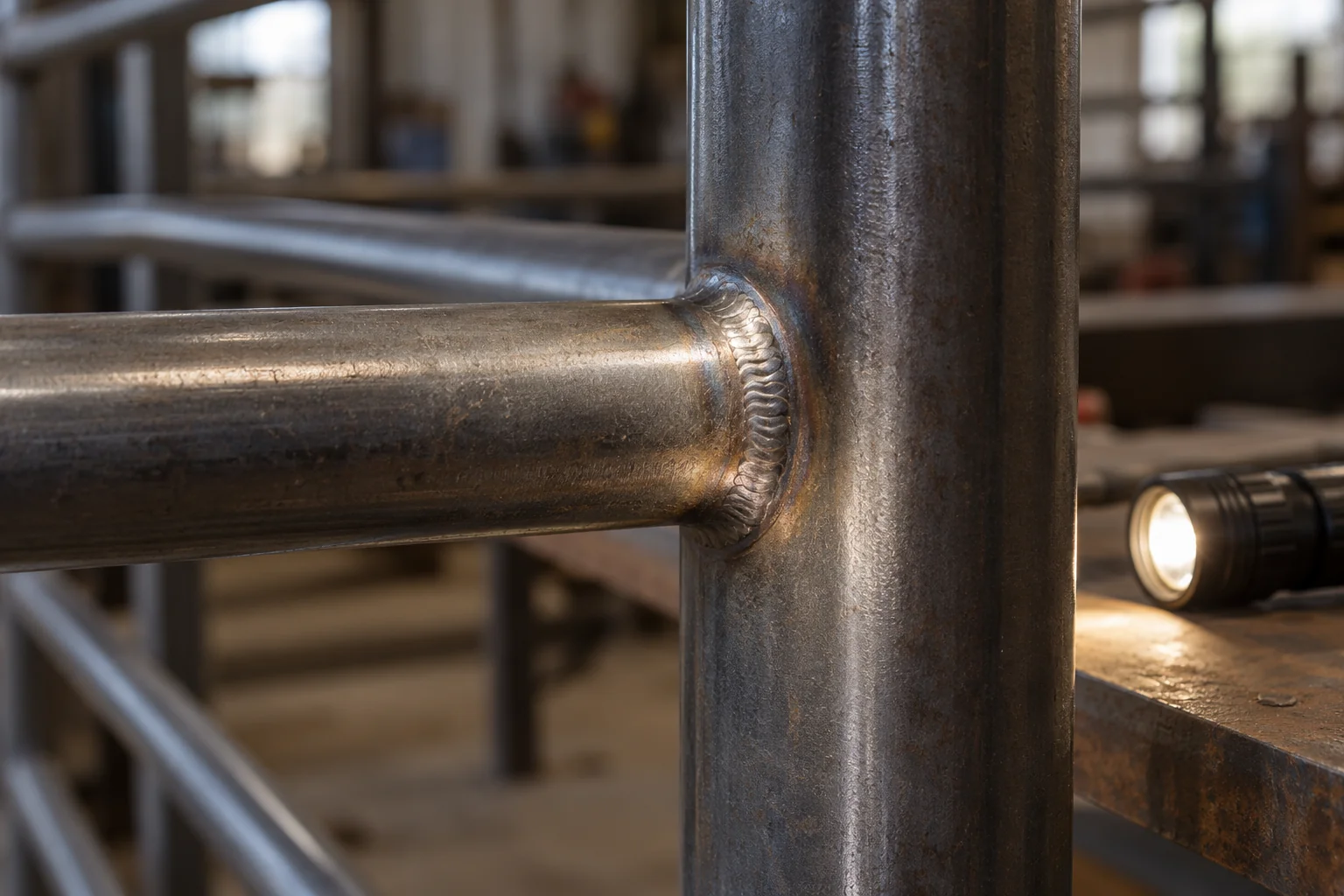
Request close views of the actual proposed joints, not only a finished product shot. Ask for the weld requirements to be identified on the production documentation and for the inspection method to be agreed before manufacture. A tidy-looking surface alone cannot establish everything about a joint.
Keep screening photographs separate from acceptance evidence. Photographs can help identify questions about distortion, sharp projections or incomplete-looking areas, but the agreed inspection should be conducted by someone competent to apply the relevant criteria. Do not prescribe destructive checks casually on delivered panels.
Then follow the connection beyond the weld. Confirm bracket dimensions, pin retention, fit with adjoining components and the intended support arrangement. A strong-looking frame connected through an undocumented interface leaves an important part of the system unanswered.
If a supplier substitutes a connector or changes a rail-to-post detail after approval, require the revision to be recorded and reviewed. Similar appearance is not sufficient justification for treating two assemblies as interchangeable.
Does the coating prove that a panel is heavy duty?
No. Coating information addresses corrosion protection and finish requirements, not a stand-alone structural rating. Keep those topics separate in the quotation so an attractive galvanized or painted surface does not distract from missing construction details.
Ask what process is proposed, when it occurs relative to fabrication, and how any repaired areas will be treated. Where hot-dip galvanizing is specified, agree the applicable inspection requirements. The American Galvanizers Association inspection guide covers coating thickness, adherence, appearance and finish; visual color alone is not the full assessment.
Describe the expected environment to the supplier, including washdown and exposure conditions, and request appropriate care instructions. Do not translate a finish name into a guaranteed service life without supporting terms and conditions.
Keep the finish specification tied to the drawing revision and order. This makes it easier to distinguish a permitted cosmetic variation from a departure that requires correction under the agreed acceptance requirements.
How can you distinguish useful evidence from paperwork?
Use a simple evidence register. For each important claim, record the document, the model it covers, its date or revision and the unresolved question. This prevents a thick folder from creating false confidence when none of the documents identify your panel.
For example, a dimensional report may establish that selected measurements met the drawing. It does not automatically prove the material grade. A material record does not automatically establish the performance of the welded assembly. A coating report does not replace either of those checks.
When reviewing a sample, label it with the agreed drawing revision and record any approved departures. Ask how the production order will be kept consistent with that sample. If a change affects the basis of the original assessment, seek a revised response rather than filing the old report beside a new drawing.
A concise set of relevant, traceable documents is more useful than unrelated certificates. Keep the decision focused on what each item actually demonstrates and what remains to be confirmed.
How should you handle a cheaper alternative specification?
Ask the supplier to present the alternative as a separate, clearly identified proposal. List each departure from the requested design and the evidence supporting the revised application. This makes a genuine value-engineering discussion possible without obscuring what has changed.
For instance, a different section profile is not automatically unacceptable, but it should not inherit the original assembly’s supporting documents without review. The same applies to a changed span, connection detail or material designation. Ask which earlier conclusions remain applicable and which need reassessment.
Keep the original compliant offer visible until the alternative is accepted. This prevents the purchasing team from approving a lower price while the operating team assumes the original construction is still being supplied. Price savings should correspond to an understood design, not an unanswered technical exception.
What belongs in the final heavy-duty purchase specification?
Complete the order with a defined application, approved construction drawing, connector schedule, finish requirements and agreed acceptance evidence. Identify who approves deviations and how questions will be resolved before production continues. Avoid leaving a crucial limitation only in an informal message.
Write the acceptance basis so another person could follow it: which dimensions are checked, which records are supplied, how the sample is identified, and what happens if a requirement is not met. Do not accept an unexplained substitution simply because its unit weight is similar.
For repeat purchases, reference the exact accepted revision rather than ordering another heavy-duty panel by name. A model label may remain unchanged while details evolve, so confirm continuity before relying on earlier documentation.
When you request a HRC panel proposal, send the working application and the evidence you need alongside your quantities. The best purchasing outcome is a clearly defined assembly with a defensible basis for selection—not the most emphatic description in a brochure.